A little water isn't going to hurt anything.

A little water isn't going to hurt anything.

People always ask me if my covers are waterproof. I always have to say that they are water-resistant. The difference is mainly that waterproof boat covers will not allow any moisture through them, regardless of how long the water has been standing, how much comes down, or whether the cover is sloped. In short, a waterproof cover is like wrapping your boat in visqueen and dropping it in a plastic bag.

Why aren’t my covers waterproof, you ask? Well, covers that won’t let water in, won’t let water out. In other words, they don’t ‘breathe,’ causing all kinds of nasty problems like mold and mildew. Waterproof covers must have vents to avoid this, and consequently, can let in even more moisture and other undesirables than a water-resistant cover.

Water-resistant materials: coated polyester, canvas, nylon

Water-proof materials: vinyl, polypropylene

Keep this in mind when shopping for a cover.

Bookmark and Share

It’s BBQ Season!

April 1, 2009

Grilling is delicious.

Grilling is delicious.

So, it snowed here in Seattle today. On April 1st. No joke.

For most Americans, however, it’s getting warmer, not colder, and its time to start firing up those grills. Most of you are doing it, too, if BBQ cover sales are any indication. Good to know that so many of you are taking steps to protect your equipment from the elements. Very prudent.

It seems like most people start out with the manufacturer cover, usually some overpriced vinyl job, rip it, then come to their senses and buy a decent BBQ cover. Vinyl’s not terrible, don’t get me wrong. It’s very affordable and basically waterproof. Unfortunately, it’s not terribly durable and can encourage mold and mildew growth because of its lack of ventilation. Generally, I prefer treated fabrics like polyester. Much stronger and with the right coating, pretty much as water-resistant. Plus, it breathes so you don’t get as much nasty stuff growing underneath when you go on vacation.

Bookmark and Share

Let's see, keep self-storage or sell the car?

Let's see, keep self-storage or sell the car?

Okay, so ‘bolstered’ is probably too strong of a word. How about ‘made less ugly’ in this economy.

“In this economy” is a phrase one hears often these days. It is both the answer to and beginning of many questions that get asked daily in offices and homes around the world. Just yesterday my boss asked me if I was going to hit my number this month. I answered, with, you guessed it, “In this economy?” I was then told that was not an excuse and to stop being such a baby, in not so many words.

With all the doom and gloom it’s easy to overlook potential opportunities. In my case, covers are a cheaper substitute for monthly storage for RVs, boats, cars, etc. Awesome. Now, will this offset the decline in sales associated with new purchases, i.e. when you buy an RV, you buy a cover? I doubt it. But the landing is a little softer because of it. Let’s hope so. Cause it’s getting close to boat cover season, baby.

Bookmark and Share

More waiting in store

More waiting in store

Around the country, efforts have increased to prevent non-native species from encroaching into America’s waterways. The most common way these plants and animals are spread, of course, is in boats. These critters attach themselves to hulls and tanks, jumping ship when you’ve put in at your newest destination. The infamous zebra mussel in the Great Lakes was spread this way, as was the hated milfoil that’s fouled props in my beloved Lake Washington for decades. Federal legislation passed last year that restricted tank discharges for commercial vehicles, and was worded so imprecisely that recreational boaters were included in the environmental dragnet. Politicians from boating states successfully lobbied to get the bill changed so that it only applied to commercial ships.

Ironically, many states are now passing laws that require inspections of these recreational boats before they are allowed to be put in local waters. States like Colorado are copying the long-standing inspection requirements of still-pristine bodies of water like Lake Tahoe. Enforcement will certainly be difficult, and cost a lot of money, but the ecological harm these non-native species can do is stratospheric. Any resident of the Great Lakes region can attest to this, with zebra mussel proliferation and declining native fish stocks due to introduced sport fish like Atlantic Salmon having major impacts there.

Bookmark and Share

Golf Cart Covers & Enclosures

December 18, 2008

Dedication

Dedication

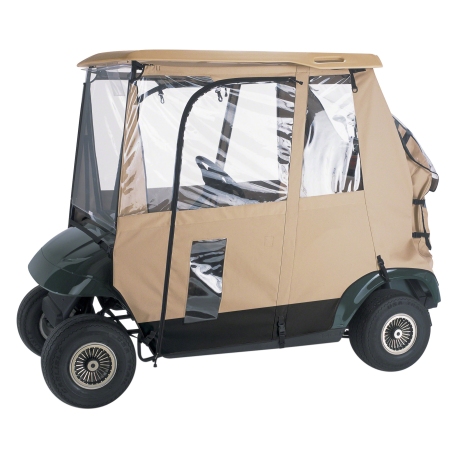
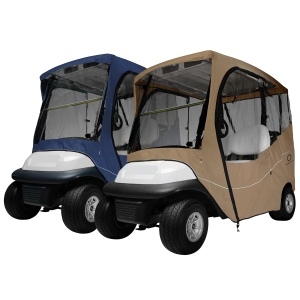
For those of us in the northern US, golf this time of year is almost unthinkable. But there is a whole region of America that is not freezing right now! Although it is snowing in Las Vegas, many southern inhabitants have been outfitting their golf carts with winter enclosures to protect against those sub-70 degree temperatures.

Some things to consider:

- Generally, the more clear plastic there is, the shorter the lifespan of the enclosure.
- Four-sided enclosures (includes a windshield) are easier to make than three-sided versions, which means they’re probably less expensive.
- 1983-99 club cars have a weird tubing support structure that makes most 3-sided enclosures require an adapter to work.
- Get lots of zippers. The more zippers, the more convenient it will be.

That’s all for today. More pearls of wisdom to follow.

Golf cart covers

Bookmark and Share

Waterproof Covers

December 18, 2008

Waterproof?  Or just resistant?

Waterproof? Or just resistant?

Everyone wants to keep the elements off of their outdoor gear.  Sun and rain are the usual suspects when it comes to damaging equipment, and a question I hear often is, “How waterproof are these covers?”

Well, covers have to do a balancing act between breathability and water-resistance.  There’s a reason people don’t just Visqueen their gear.  While almost completely impermeable to moisture, the same is true of air, meaning that with little circulation, the interior of these covers become little terrariums, with closed ecosystems that produce mold and mildew.  That’s not good.  So, manufacturers use synthetic fabrics for breathability, then usually coat them with a layer of plastic or acrylic to make them more resistant to moisture, not to mention UV radiation.

If someone promises that their covers are waterproof, be wary.  Even if they’re telling the truth, you probably don’t want to use them.

For instance, probably a lie:

Water proof covers

More accurate:

Water resistant covers

Bookmark and Share

They're even colored green!

They're even colored green!

I know, I know.  Could the timing be any worse?  A crippled economy and plunging gas prices have pushed environmental concerns to the back burner, but I applaud Classic Accessories for taking this step towards cleaning up their cover business.  They’ve basically duplicated their very successful Veranda line of covers in form, style and function, but have eliminated half the packaging, made the rest recyclable, and eliminated the use of PVC.  Long the bane of factory workers everywhere, PVC, or Polyvinyl Chloride, is very nasty stuff to make, and has actually been found to cause cancer in those who handle it in the manufacturing process.  Some studies have also shown that PVC can release small amounts of toxic stuff into the air or liquid around it.  The FDA has deemed these amounts too small to hurt you, so don’t worry about it too much.  But its still bad stuff.  So kudos to Classic Accessories. 

Here’s a link to where you’ll be able to find them:

Eco Patio Furniture Covers

Bookmark and Share

Follow Me

Follow Me

A recent study done at the University of Kentucky claims that age requirements may not be enoug to determine a rider’s ability to safely control an ATV. The study notes that many riders who meet age guidelines do not have the physical strength to safely operate an all terrain vehicle.

The study notes these discrepanices between age and size, pointing out that matching engine sizes to ages is not adequate to insure that riders are capable. The study also points out that 100 children died in ATV-related crashes last year, and that 90% of ATV child fatalities occurred when the vehicles were driven by riders who were too young for the size of the engine.

ATVs have continued to grow in popularity, and, as accidents increase in frequency, many state and local governments have passed increasingly restrictive laws that limit where ATVs can be driven and who can ride them. Minnessota recently passed legislation prohibiting motor vehicles from using state trails during hunting season for safety reasons, for example. While extremely fun to operate under safe conditions, ATVs are not toys and must be ridden responsibly. Riders who do not do so have greatly contributed to the growing acrimony between riders and other groups who use the outdoors for recreation. It is probably in the best interests of ATV groups to propose their own legislation that regulates ATV use, as there appears to be a growing sentiment that these machines are not given enough attention by state and local laws. Riders, even in states with powerful ATV lobbies like Minnesota, could find themselves left out in the cold in the debate if they’re not careful.

Article as reported by Jeffrey McMurray of the Pocono Record.

Bookmark and Share

ATV’s Getting Street Legal?

September 3, 2008

Is camo really a good idea?

Is camo really a good idea?

A number of smaller towns are legalizing ATV use on their city-owned roads.  Reasons for this include the growing popularity of the vehicles and higher gas prices that make fuel-efficient ATV’s more practical for short trips.  The ordinances that I have seen only allow ATV’s to be driven dring the day, and cannot allow ATV drivers to use state-owned roads, just those owned by the city.  This is probably OK for those living in smaller towns with minimal traffic, but can you imagine getting in a wreck with a car in one of these things?  Looks like motorcycles have lost their title of King Deathtrap on American roads.  UTVs/side-by-sides are also included in some of these ordinances. 

Articles:

Sidney, NE

Marshall, MO

Bookmark and Share

Easy RV Cover Installation

August 13, 2008

How To Easily Put on RV Cover

How To Easily Put On RV Cover

RVs are big. As such, RV covers are big, too. They can weigh 20-60 lbs depending on the thickness of the material, and, be as long as 40 feet. How to put one of these on single-handed? Sure, you could struggle for half an hour putting each corner in place, climbing up on the ladder and scrambling to keep the thing straight. Or, you could follow the diagram above for an easy and stress-free experience. Just tie two ropes to the ends of the long side of the cover. Throw ropes over cover to side you will pull cover on from. Walk around to side ends of rope are one. Grab ropes. Walk backward slowly, keeping cover decently aligned with the RV. Use broom stick or something else long to fine-tune the fitment. You are done. Wasn’t that easy? Congratulations on your new bit of knowledge.

Bookmark and Share